
By Dr. Phil R. Bell, Associate Professor at the University of New England in Armidale, Australia.
Between 2011 and 2013, I worked as the palaeontologist for the Philip J. Currie Dinosaur Museum—then, nothing more than a concept drawing—helping to design the exhibits and, best of all, finding and excavating dinosaurs to exhibit. At that stage, Grande Prairie was known for two things: oil and Pachyrhinosaurus.
Fortunately, it wasn’t just me searching for fossils. During the summer of 2012, a staffer at Northwestern Polytechnic (then Grande Prairie Regional College), Katalin Ormay, found a string of dinosaur vertebrae on a large, coffin-sized boulder on the banks of the Redwillow River, an area now renowned for its dinosaur fossils. Armed with photos of the spot, I visited the site with fellow palaeontologists Federico Fanti (University of Bologna) and Mike Burns (now at Jacksonville State University) and identified the vertebrae as belonging to a hadrosaurid (‘duck-billed’ dinosaur), a common find in these Cretaceous rocks.
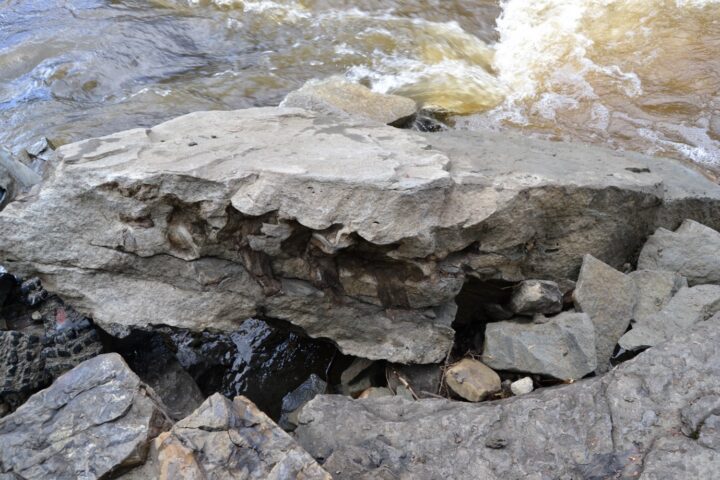
The famous ‘crested edmontosaur’ as it first appeared, half submerged, in 2012. The vertebrae you can see are upside down and come from the neck. Unknown to us, the back of the skull is buried in rock to the right of the vertebrae.
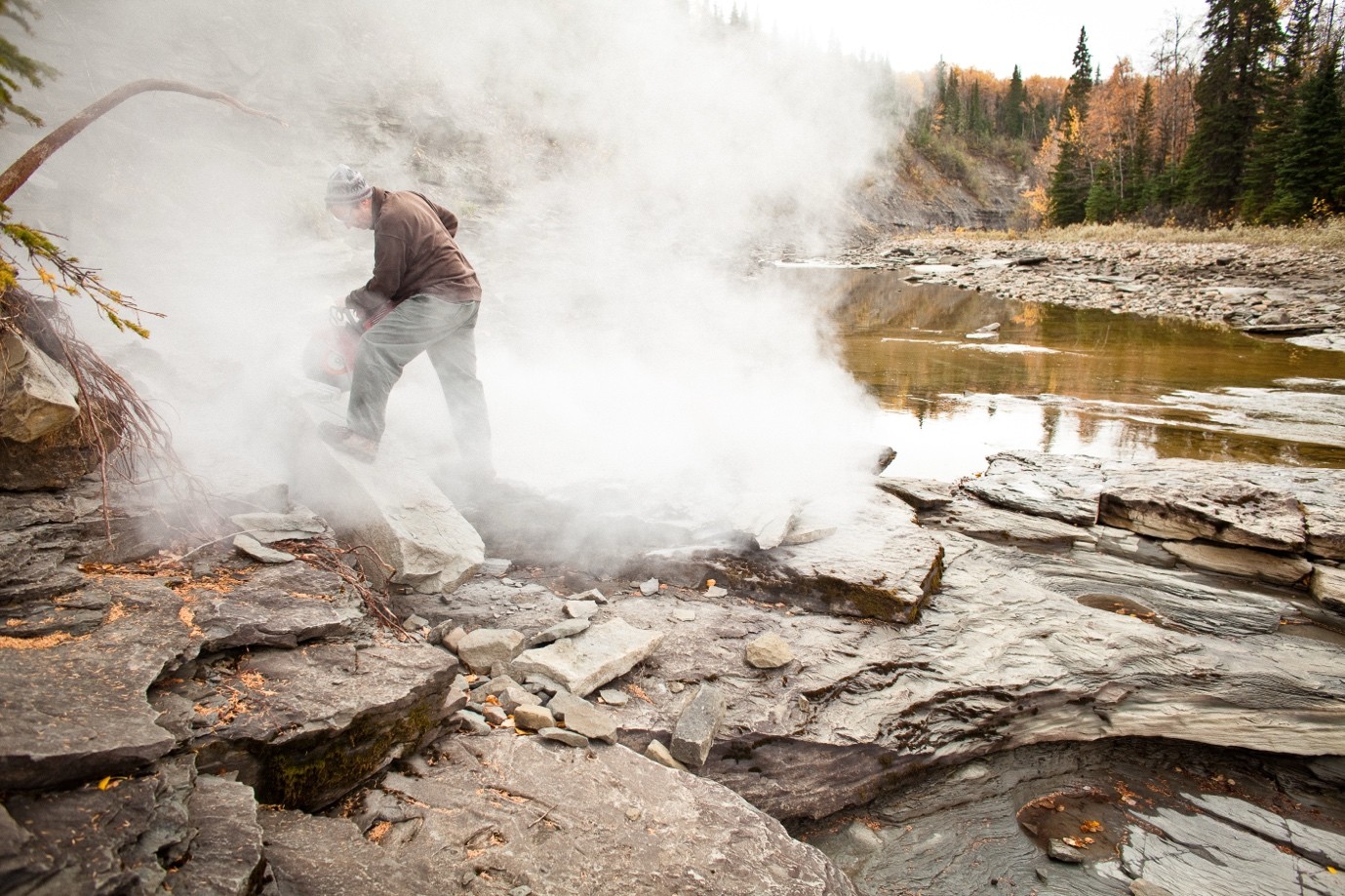
What wasn’t so common though, was the fact that they were articulated, neatly arranged as they would have been in life. Based on that fact alone, we determined to collect it, much to the chagrin of veteran bone hunter Clive Coy (University of Alberta) who was dispatched from Edmonton to help. In southern Alberta, where Clive had spent decades working, bones like these would be scorned as uninformative, because much better hadrosaurid specimens already clogged museum collections throughout the province. In Grande Prairie at the time, however, articulated remains were rare. Because of its unwieldy size, we took a petrol-powered concrete saw to the huge block with the aim of cutting away the extraneous rock so that we were left with only the vertebrae.
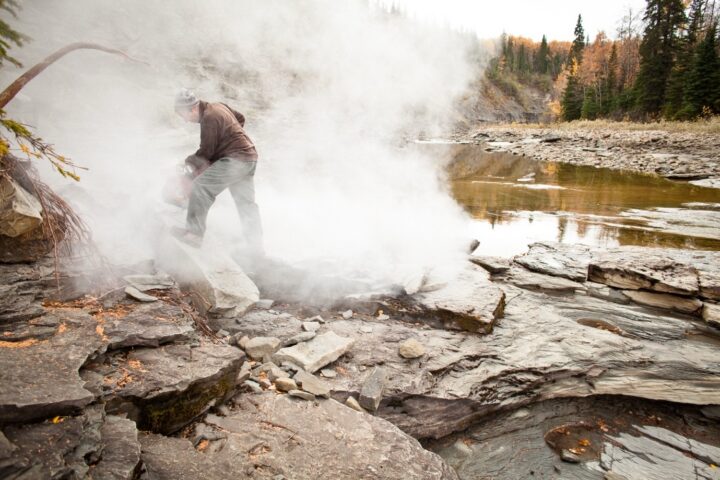
Clive Coy, dinosaur technician at the University of Alberta, wields a rock saw in what turned out to be a very brief attempt to cut down the size of the block. Photo: Chris Beauchamp.
The process should have been a simple one: Clive would deliver a number of parallel cuts and I would then break off the intervening rock with a hammer and chisel. Repeating this innumerable times would allow us to safely break the block down to a much more manageable size. As luck would have it, however, the very first hammer blows revealed the unmistakeable tessellated texture of fossilised skin!
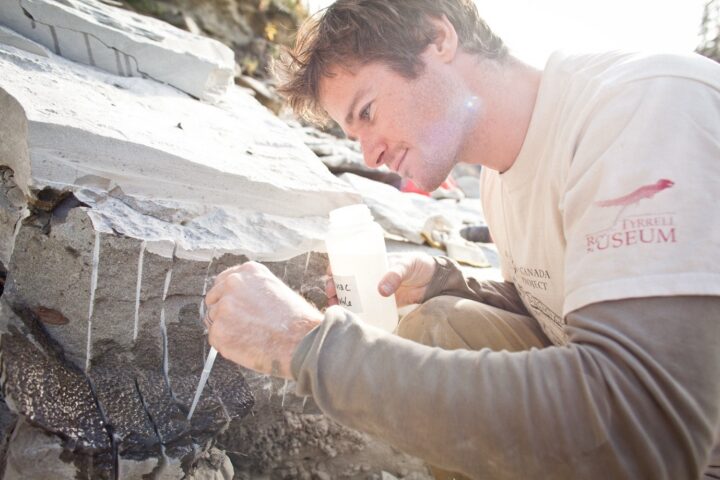
Those first few cuts from the rock saw revealed a hidden surprise. Here, I quickly douse the newly exposed skin with glue to preserve it. Photo: Chris Beauchamp.
With a mixture of excitement and consternation, we called a halt to the progress: the entire block would have to be collected as it was. We returned on a chilly autumn day with an indefatigable fossil fanatic, namely the late Roy Bickell, and a couple of quads to perform the delicate operating of winching the giant slab onto Roy’s quad trailer.
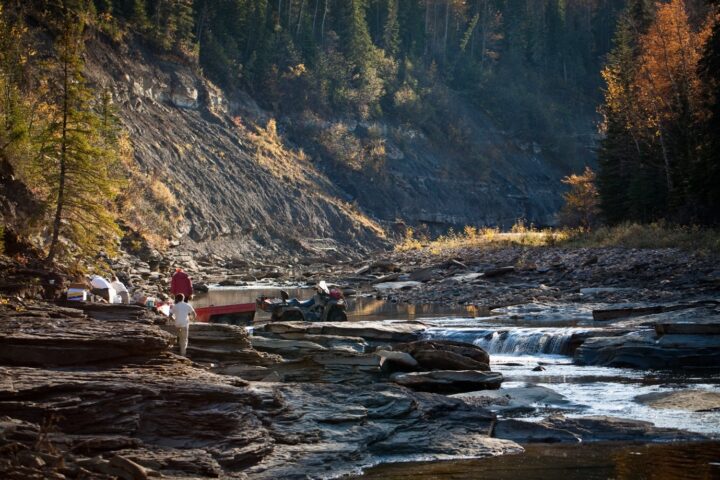
The late Roy Bickell (in the red jacket) with his trusty quad assists in the removal of the large block, which was found in a difficult-to-access section of the river valley. Photo: Chris Beauchamp.
At last, safe in the lab, Robin Sissons and I spent the winter of 2012/2013 using airscribes to disinter the specimen from its rocky tomb. As the work proceeded, the beautiful patterns of the skin emerged. Importantly, we could see oval-shaped clusters of large scales set within a web of much smaller, bead-like scales, a pattern characteristic of the hadrosaurid Edmontosaurus. This identification was confirmed when the back part of the skull was later revealed. Now, as a supposed ‘expert’ on duck-billed dinosaurs, I thought I knew a thing or two about the anatomy of these animals.
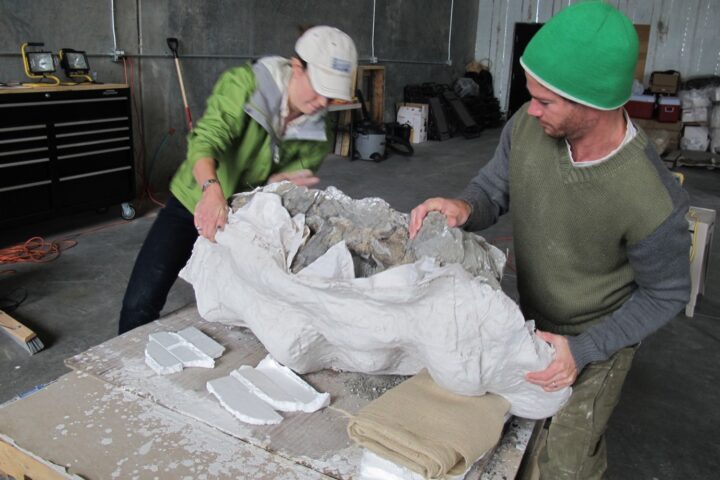
Robin Sissons and I wrestled the block for many months (not always in this manner) to slowly strip away the rock and reveal the fossilised skin. Here, we’re flipping the bock to prepare its ‘underside’, the side that would rewrite what we thought we knew about dinosaur appearances.
Most salient is the fact that Edmontosaurus is a rather bland looking species with an unremarkable horse-like skull, quite removed from the flamboyantly ‘crested’ group of hadrosaurids known as lambeosaurines.
Armed with this knowledge, I assumed that the large chunk of hard rock that still obscured the top of the specimen’s skull could be more brazenly removed with a hammer and chisel without the risk of damaging anything. How wrong I was. The experience with the rock saw should have taught me to expect the unexpected, but when those first few blows with the hammer revealed even more skin, I was puzzled more than anything. This section was nowhere near the head or the rest of the body, so why was there skin here? Further, more careful coaxing with the airscribe eventually revealed something unprecedented: a three-dimensionally preserved mound of scale-covered flesh sitting atop the back of the skull.
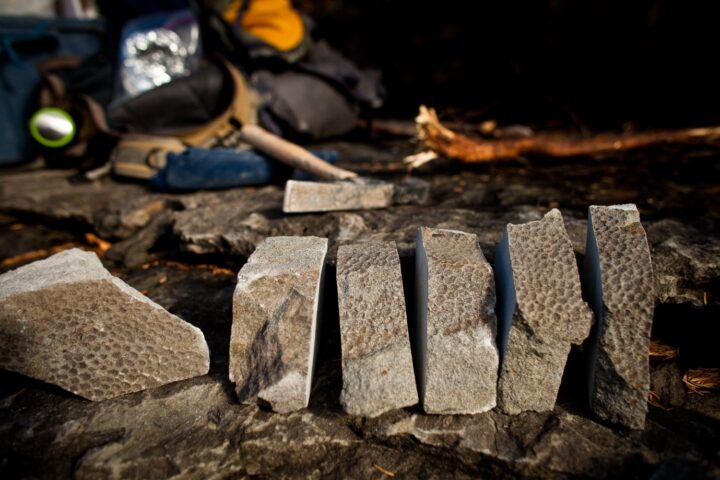
After the main block was cut with a rock saw, a hammer and chisel were used to remove the extraneous rock. These freshly broken pieces revealed the ornate, polygonal scales of the hadrosaur buried within. Photo: Chris Beauchamp.
The end result was a dinosaur like no other. The genus Edmontosaurus had been known since 1917 along with dozens of skeletons, skulls and even well-preserved ‘mummified’ specimens. After a century of intensive study, we thought we knew what this animal—one of the best-known dinosaurs of all time—looked like. Yet here was a dinosaur whose preserved soft tissues would not only rewrite the way we would reconstruct Edmontosaurus, but also opened the floodgates for the reconstruction of dinosaurs in general.
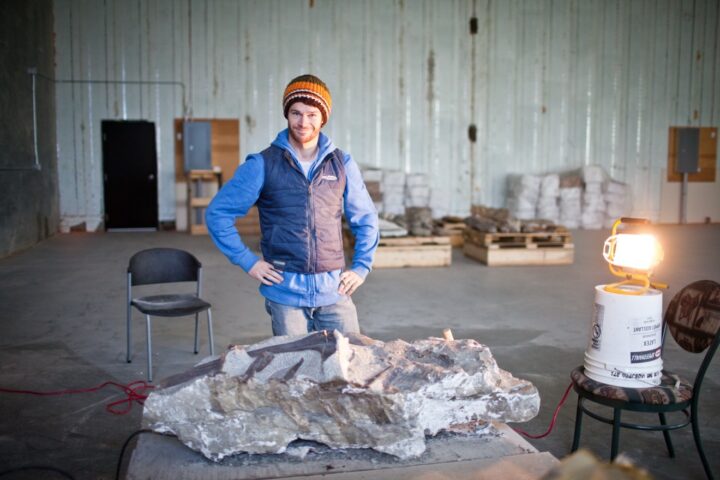
Pleased with the progress so far in early 2013. Only one side of the block had been prepared at this point and the fleshy crest was still buried deep in the rock, yet to be discovered. Photo: Chris Beauchamp.
We likened the fleshy crest to the bright comb on a rooster’s head and published our work in the scientific journal Current Biology in 2014. Julius Csotonyi’s evocative reconstruction of the animal graced the cover and I was quietly tickled with the results: we’d not only shown that Grande Prairie was more than just pachyrhinosaurs but had successfully tipped our preconception of dinosaur appearances on its very fleshy head! We also ended up with what I consider the most important exhibit now on display at the Currie Dinosaur Museum.
Go see it for yourself and let us know what you think!
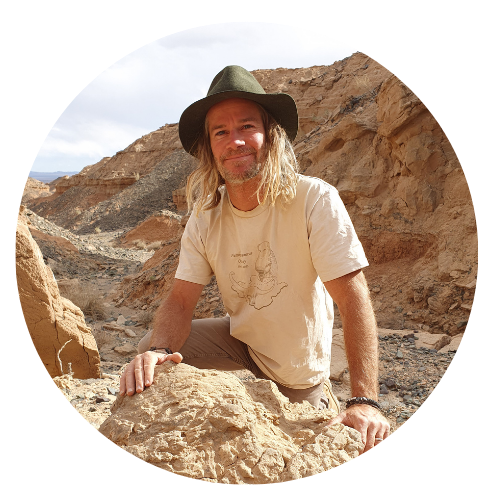
Dr. Phil Bell is an Associate Professor at the University of New England in Armidale, Australia where he teaches palaeontology. He has worked in the Canadian badlands and in the Grande Prairie region for over two decades in the pursuit of Cretaceous dinosaurs.
Learn more about his work at the Palaeoscience Research Centre at UNE.
Email your Palaeo questions to info@dinomuseum.ca! ✏