
Demystifying the way the science actually works
By Lindsay Kastroll
How exciting! A palaeontologist has found a fossil that they want to collect…Now what? In this installment of Palaeo How-To, we’ll be following up on the concept of “prospecting,” or searching for fossils, that we discussed in the last post.
Fossil collection is a general term for many techniques that a palaeontologist might use to temporarily repair, protect, and transport a specimen so that it can be safely delivered to a museum, a university, or another institution with the means to take care of and study fossils. The collection techniques that are applied will vary depending on the conditions of preservation of the fossil. What type of fossil is it? How much erosion has occurred? Is the specimen isolated, or part of a larger assemblage? My explanation below is based on my personal experience with Albertan dinosaur fossils, but much of it is applicable to many other types of fossils as well.
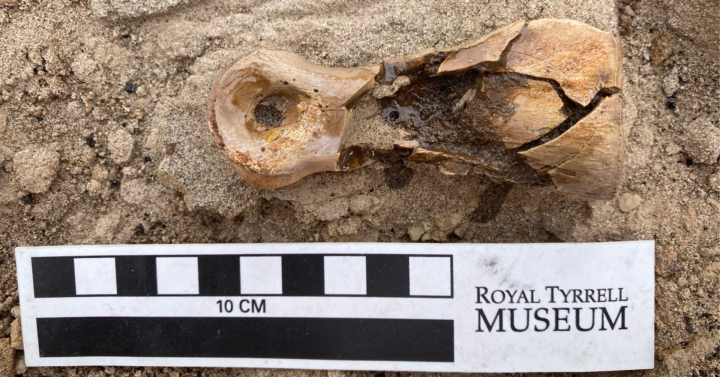
This small fossil, a toe bone from a theropod dinosaur, was found broken. Palaeontologists applied glue to stabilize the breaks before a plaster jacket was applied. The dried jacket was bagged along with loose fragments found nearby and a descriptive tag.
The easiest fossils to collect are small, well-preserved bones sitting on the surface. When we find them, we’ll typically zip them up in a plastic baggie alongside an informative specimen tag. Every specimen we find, large or small, receives one of these paper labels so that we can record the specimen’s field number, our best guess at an identification (which sometimes proves to be wrong!), the name of the collector, the date, and the location. By placing the specimen and tag in the bag together, we ensure that they won’t be separated, at least any time soon. One of the easiest ways fossils become “lost” in a museum or research setting is when they are accidentally separated from the basic information that describes them. Recall last time when we said that information about a fossil’s context is extremely valuable – if we can’t remember where a specimen came from, much of its usefulness is lost!
What if the specimen is not in good condition? If the specimen is broken into pieces, the first order of business is to try to collect them all. If we’re lucky, erosion won’t have spread the pieces too far apart or destroyed them too badly, so that they can still be assembled when they return to the lab. Next, we stabilize any cracks and breaks. Most palaeontologists use a special type of glue that dissolves in acetone, a quick-drying chemical commonly found in nail polish remover. This means that we can prepare different viscosities of glue to use in different circumstances, and more importantly means that we can remove the glue if need be by applying more acetone. Once a fragile specimen has been stabilized, it can be further protected with something like paper towel or aluminum foil, and then bagged and tagged as usual.
Sometimes glue isn’t enough, and we have to employ a plaster jacket. Plaster jackets are support structures, essentially identical in purpose and composition to a traditional cast that immobilizes a broken bone. They are made by mixing together a slurry of plaster and water, which becomes a delightful goop that we use to coat strips of burlap or other fabric (including fiberglass cloth if it needs to be light and sturdy, especially once back in the lab). By zigzagging the strips of fabric in layers across the specimen, we are able to create a “jacket” that conforms to its shape, and once the plaster dries, immobilizes it so that no further breakage can happen during transport. The plaster gives the jacket its hardness, while the strips hold it together. Sometimes we will only jacket the top side of the specimen, so that when we flip it over, it is held in a solid bowl. Other times, we want to be extra sure that the specimen will be protected, so after it is flipped over, we repeat the process to completely encase it.
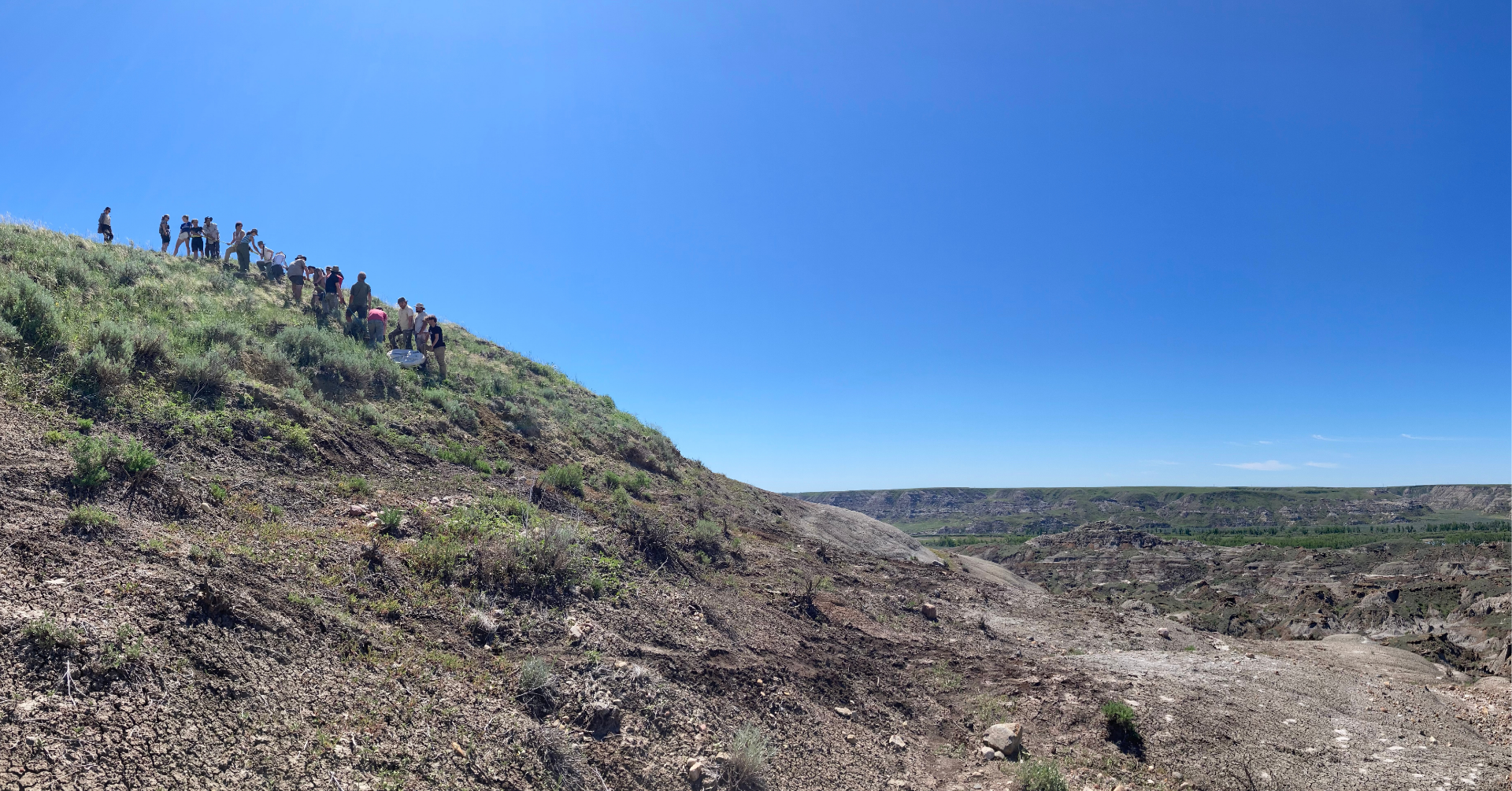
In summer 2024, the University of Alberta and McGill University field crews joined forces to tow the massive skull of a Lambeosaurus nicknamed Scorpio out of the badlands in its plaster jacket. We estimate that the specimen and jacket combined weighed over 600 pounds!
For better or worse, not all fossils simply sit on the surface, waiting for palaeontologists to jacket and collect them. Many are still embedded in the stone, and remain undetected until a small portion is exposed by erosion. Embedded fossils are often in better shape than surface fossils because the surrounding rock has largely protected them from damage. This is a major win for palaeontology, but unfortunately, it can come with some major work for palaeontologists! Excavating a fossil requires the use of a variety of tools that are lugged out to the field every day. Common field tools might include rock hammers, awls, chisels, trowels, and brushes of various sizes. Isolated fossils (single bones and teeth that are not accompanied by other parts of the same individual) are often small projects, which might require a day of work by a pair of palaeontologists (we always prospect in pairs for safety purposes!). Larger projects, like partial/complete skeletons or bonebeds, demand that we dig a quarry.
In palaeontology, a quarry is an area that we excavate to uncover and collect a large or extensive fossil deposit which is covered by a layer of overlying rock, called overburden. Overburden removal is often the most grueling part of quarry work; manual removal using tools such as pickaxes, crackhammers, rocksaws, shovels, and potentially even jackhammers is exhausting, and if the fossils lead back into a hillside, there can be tons of overburden that must be cleared away! Often, however, the work is rewarding as more fossils are uncovered. As quarrying proceeds, all the fossils are meticulously mapped by hand and documented with photographs so that even if they are removed one by one, we will always have a record of their original positions and orientations, which can be useful in a variety of ways. If a specimen was found in articulation, for example, the map records how the skeleton was arranged when found. If palaeontologists suspect that the fossils in a bonebed were transported by a stream, their orientations may indicate the direction of the current.
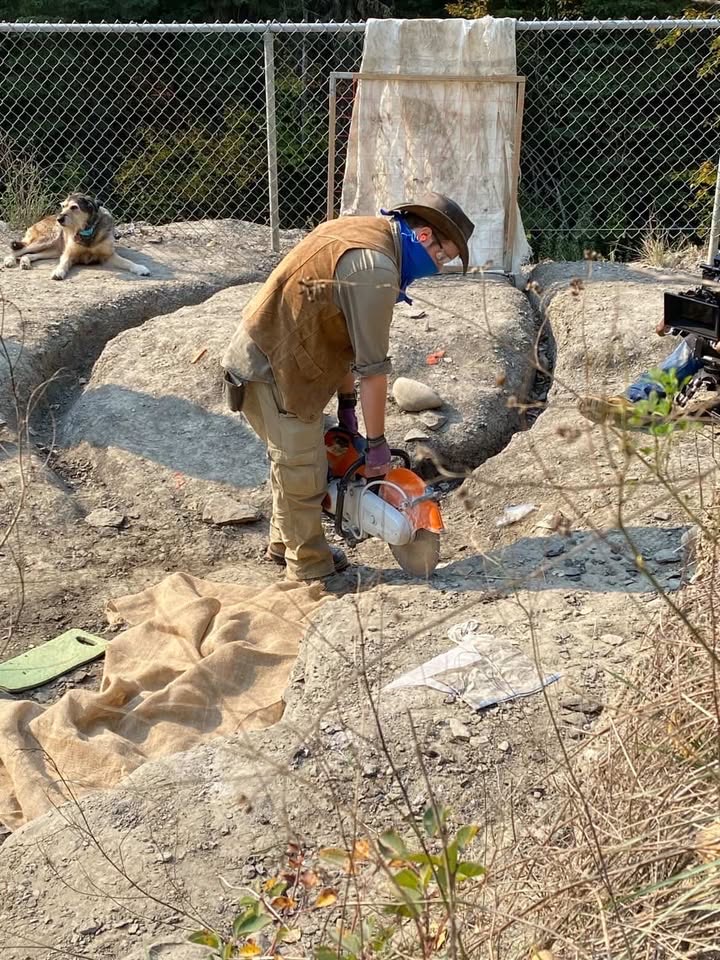
Palaeontologist Maximilian Scott prepares to saw through the overburden that caps the Pipestone Creek Bonebed. Since the rocksaw generates a lot of dust, Max has donned protective gear and covered the bones with a tarp.
So, palaeontologists have found a significant fossil! They’ve excavated it, mapped it, and given it a plaster jacket. What’s next? Permits to collect fossils in Alberta specify that the palaeontologists must bring them back to a suitable facility to be studied and cared for. But when you’re in remote badlands or river valleys, that can be easier said than done. Small fossils are simple enough to carry out in your field pack, but larger ones can be far more difficult to hike with. Remember that fossils have been slowly replaced by or pressed into solid rock, and rocks can be very heavy. Often the field crew has to either take turns with heavy specimens, carry them in tandem, or even fashion makeshift stretchers out of branches and burlap.
Some fossils are simply too big for a crew to carry, and require a lot of logistics. If we’re lucky, the specimen will be located somewhere that can be accessed by truck, ATV… or even boat. Otherwise, we may end up attaching a tow strap to a plaster jacket so that 20+ volunteers can haul it through inaccessible terrain (horses must have been great to have around in Gilded Age palaeontology). If even that is not feasible, then that’s when palaeontologists have to call in the big guns; it’s always a thrill to see all your hard work dangling precariously beneath a helicopter!
 Email your Palaeo questions to info@dinomuseum.ca!
About the Author
Lindsay Kastroll
Master’s Alumnus, Biological Sciences, University of Alberta · Writing Contractor, Prehistoric Kingdom
Lindsay graduated with a Master’s in Biological Sciences from the University of Alberta in 2025. Lindsay’s master’s research focused on the skulls of Pachyrhinosaurus lakustai at the Pipestone Creek Bonebed. Lindsay is also a writing contractor for the video game Prehistoric Kingdom!